Nobody: To Each Brave Soul That Dares to Begin
"I want to live the life I want to live."
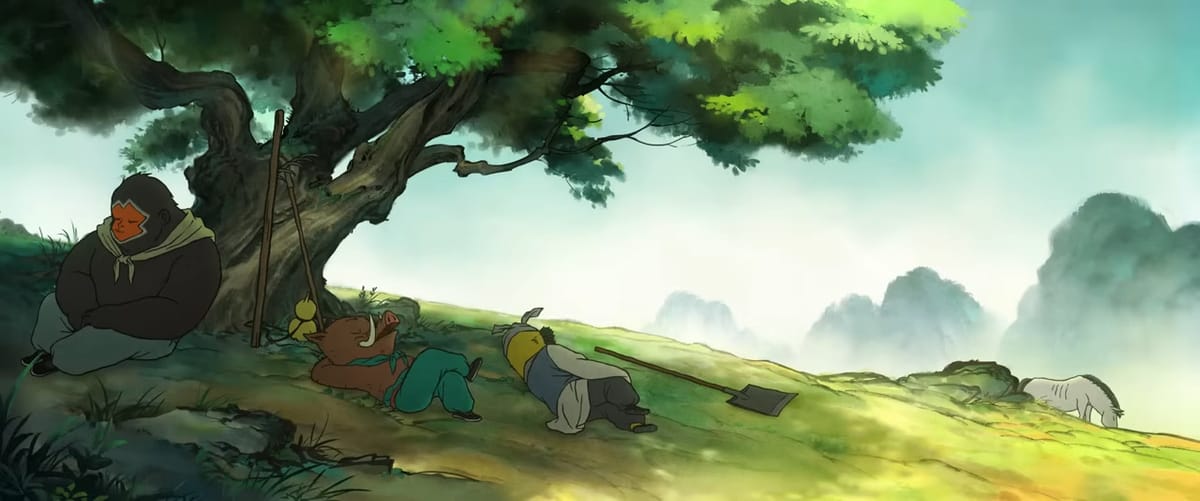
It is a truth universally acknowledged that a child learning Chinese will become obsessed with Journey to the West. In case you’ve been trapped under a mountain for 500 years and haven’t heard of it, it’s a classic Chinese novel about Sun Wukong, a monkey who seeks the Buddhist scriptures in India with Sanzang the monk, Zhu Bajie the pig, Sha Wujing the river monster, and a horse (who is really a dragon). Along the way they face off against countless monsters looking to devour the monk’s flesh and obtain immortality for themselves.
Journey to the West is written in classical Chinese, so as a kid learning the language I was reliant on English translations. The first version I found at the public library (Arthur Waley’s Monkey) gave me what I was expecting. When I tracked down W.J.F. Jenner’s unabridged edition in high school, though, I was bewildered to find it had poetry. This isn’t unheard of in classic Chinese novels, but it was my first indication that this wasn’t the rollicking adventure story I expected.

Journey to the West is a creation myth, a collection of folk tales, and a treatise on how to be a person. Scholars still debate the story’s deeper meaning or whether its true author was Wu Cheng’en. Beneath those larger questions though are the smaller, niggling ones. Why is Wukong so much stronger than anybody else? Do the Buddha and Sanzang really have the right to treat him so poorly? Also, shouldn’t Bajie or Wujing have their time to shine, too?
The 2025 animated film Nobody is built from these niggling questions. Its heroes aren’t Wukong or Sanzang. They aren’t even Bajie or Wujing. Pig, Frog, Weasel and Ape are demons, not heroes. They work menial jobs for demon kings and scam passing travellers. They’re cannon fodder.
It’s Pig who first asks himself, “what if I was more?” With the help of Frog, his long-suffering friend, he recruits Weasel and Ape. They disguise themselves as Sanzang and his men. Initially they are content begging for alms. As their ambitions grow, they set their eyes on India. So long as they remain one step ahead of Wukong, they, rather than him, might ascend to Buddhahood.
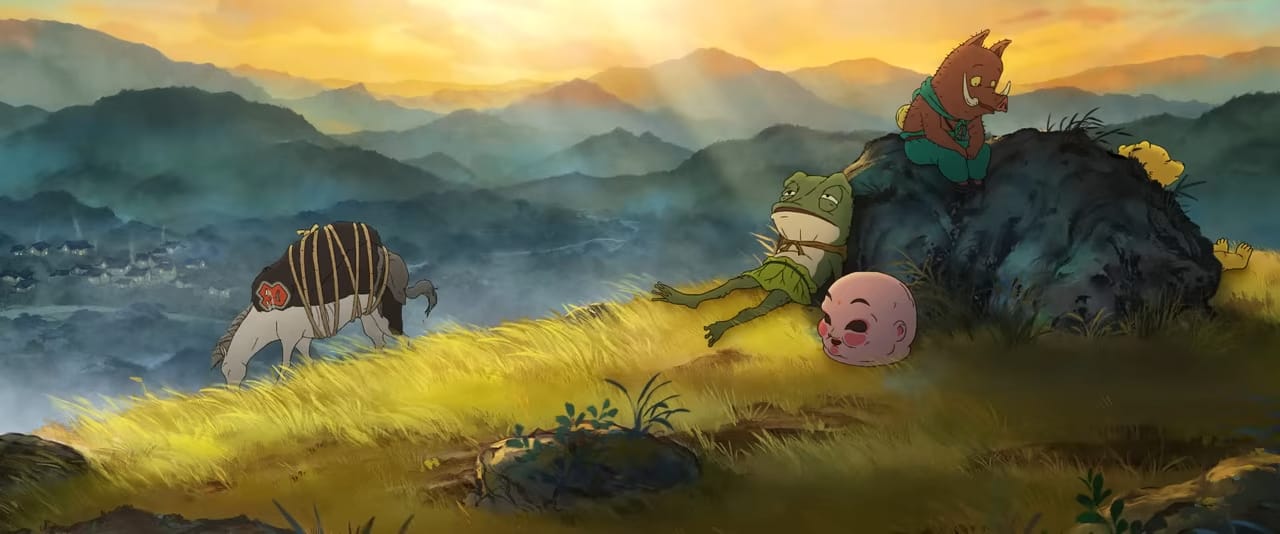
The joke of Nobody is that each of these four characters is nothing like their double. Frog is a toady and a coward, the opposite of the noble Sanzang. Weasel says more words in a minute than Wujing has in his life. Ape lacks Wukong’s charisma. Pig is the group’s leader, which makes him the spiritual opposite of lazy and gluttonous Bajie. As his crew earn the love and respect of people they meet along the way, though, they grow into their roles.
That contrast between the cosmic and the down-to-earth reflects the film’s origins. As Animation Obsessive writes, Nobody was animated by Shanghai Animation Film Studio, responsible for classics like Havoc in Heaven and Nezha Conquers the Dragon King. Despite the studio’s prestige, Nobody was animated in 2D for less than $10 million. It’s a world away from the outrageous scale of is peer Nezha 2.

Nobody remains appealing on its own merits. The animators at Shanghai Animation Film Studio make creative use of the film’s limited budget to punch up its jokes. Backgrounds evoke the texture and feel (rather than literal truth) of Chinese ink painting. It’s a pleasure just to be there in the world with Pig and his friends as they travel from place to place. As they find peace and contentment together in mountain greenery, you understand just why the journey matters so much to them.
In one of the film’s best scenes, Pig stops along the way to visit his family. We learn that his father is bedridden and his mother can barely feed her young children. Even so, they are overjoyed to see Pig return home. This sequence punches a hole in one of the source material’s most fundamental assumptions: that all demons are heartless and deserve death. If Pig has a family, does every other demon in this world have a family, too? Wouldn’t that make the heroic Wukong a mass murderer?

As it turns out, the Wukong of Nobody is no villain. He’s one of the few mythical characters in the film to offer Pig and his comrades grace. The real villain of Nobody is hierarchy. Demon kings accumulate power through murder. They bully their peers to maintain it. Then they are crushed by others appointed by the Buddha. Demons working under a demon king have it even worse; the world condemns them to either servitude or death.
The Buddha sits atop the film’s world, just as he does in the original Journal to the West. He descends at the end to confirm that Pig’s story was only just marginalia. Never mind that children were endangered. Wukong’s journey must proceed on schedule. When the Buddha’s assistant asks him, “what about those four,” he only laughs. That’s the guy I remember who buried Wukong under a mountain for 500 years.

Nobody remains optimistic, even sentimental, about our ability to change for the better. But while Pig and his friends have much to gain from becoming “important at work,” they also have plenty to lose. People they promised to meet again, family they love. That the protagonists know what sacrifice they are making, and are driven by their values to do it anyway, makes the ending hurt that much more. Their reward is not power or immortality but the respect of the people they met along the way.
The climactic battle seemingly pays tribute to the animated film Mind Game, as Pig, Frog, Weasel and Ape sprint through the villain’s ultimate special attack. As reality breaks down and metaphors are flung at the protagonists like burning trucks, the heroes are propelled forward only by their burning desire. The same desire that, perhaps, empowered director Yu Shui and Shanghai Animation Film Studio to make this movie: “I want to live the life I want to live.”
AMV of the Week
Here's "The Monkie Limit" by SilkAMV.